BeaverCube
Led ADCS development, wrote flight code, and advised student teams through launch and ISS deployment in 2022.
Mission paper →Research
What a spacecraft can do depends on its hardware, how well it understands that hardware, and how it uses it. I study those choices together.
01 / Adaptable spacecraft
A small satellite may have limited sensors and actuators. A better model of its motion can help it estimate where it is pointing, understand persistent errors, and plan maneuvers that its hardware can actually perform.
My dynamics-aware estimators combine sensor measurements with a model of spacecraft motion. They estimate attitude and angular velocity together with quantities such as sensor biases, actuator biases, and disturbance parameters. Separating these uncertainties helps improve both the state estimate and the model used for control.
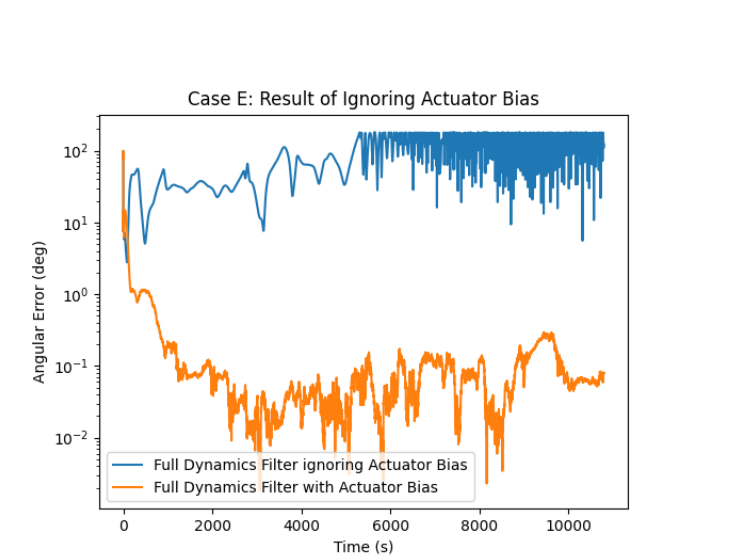
The configurable extended and unscented Kalman filters augment the state with selected bias and disturbance parameters. The spacecraft model supplies the dynamics, sensor predictions, and associated derivatives. Which quantities can be distinguished depends on the measurements and the motion: adding parameters alone does not make them observable.
The plotted result is a particular simulation case, not a general accuracy guarantee. Sensor assumptions, initialization, and disturbance models are specified in the paper.
Magnetic actuators push against Earth’s magnetic field, so the directions in which they can turn a satellite change along its orbit. My attitude-planning work anticipates those changes to find maneuvers that feedback alone can struggle to complete.
Result · Paired simulation study
84% versus 27% of magnetorquer-only trials reached less than 5° final pointing error with the trajectory planner versus magnetic PD feedback.
100 paired trials · 1,000 s horizon · reduced-attitude pointing task. This is final acquisition performance, not a measure of sustained pointing precision.
The planner uses constrained nonlinear trajectory optimization to account for dynamics and available actuation. The broader method includes pointing constraints, disturbances, and reaction-wheel momentum where applicable. The attitude-planning methods underlie the SALTRO implementation.
A planner cannot create a missing controllable direction. The published comparisons distinguish tasks appropriate to each actuator configuration from mismatched full-attitude tasks.
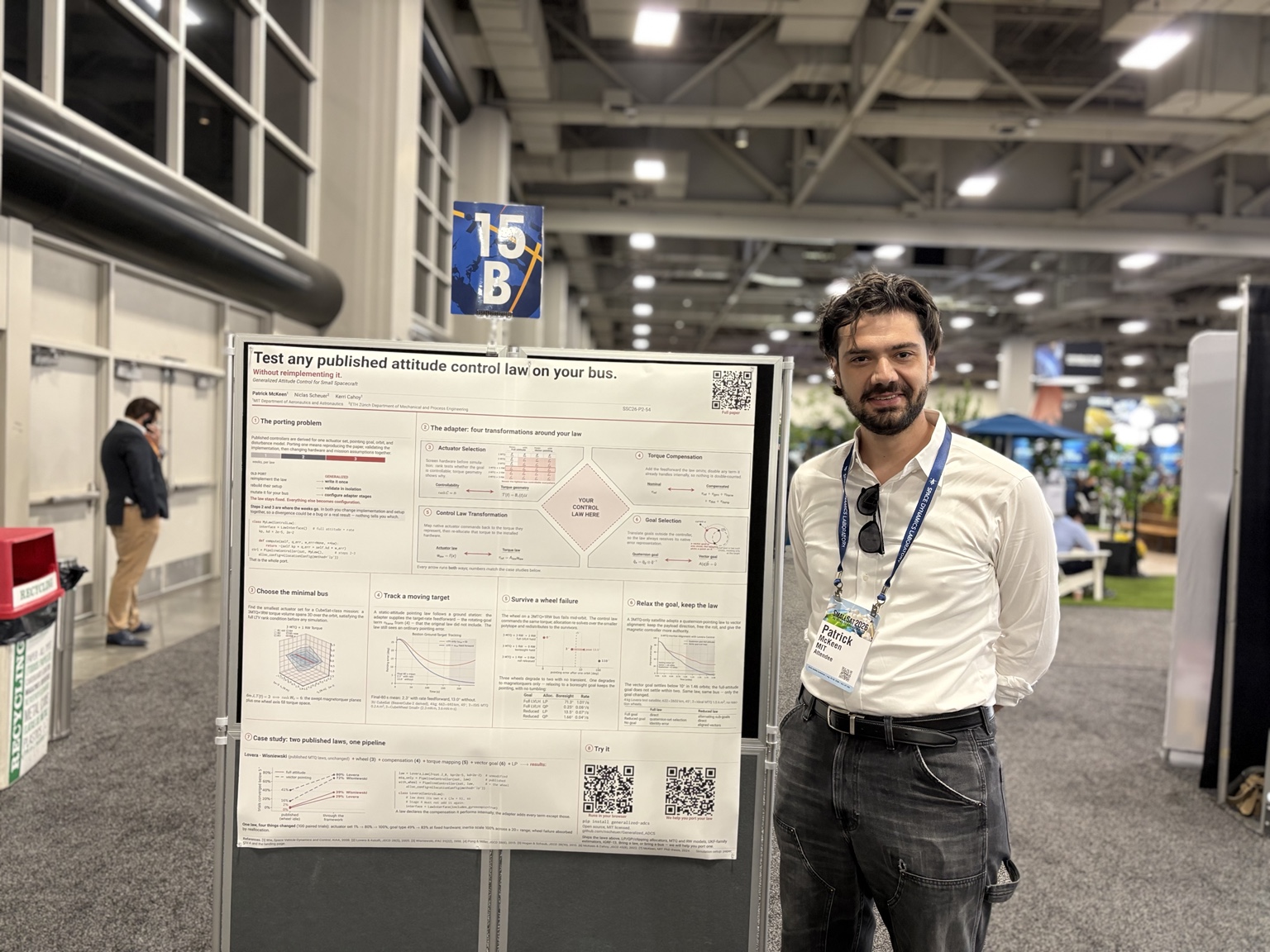
I originated Generalized ACS to transfer existing control laws across spacecraft, pointing goals, and actuator configurations. It provides a common mathematical structure for connecting a desired pointing behavior to the torques and actuator commands a spacecraft can produce.
GenADCS is the accompanying software framework for modeling and comparing estimation, control, and planning methods. The reusable software and the mathematical approach are complementary parts of this work.
02 / Coordinated missions
Satellites experience drag and pressure from sunlight. By changing their attitude, they can change those forces. I investigate how to use that control authority to maintain close formations while reducing reliance on propulsion.
I developed a decentralized formation-control strategy using differential drag and solar radiation pressure for in-plane formation-keeping. Formation geometry, navigation uncertainty, and control authority all affect how closely satellites can operate and what happens after a failure.
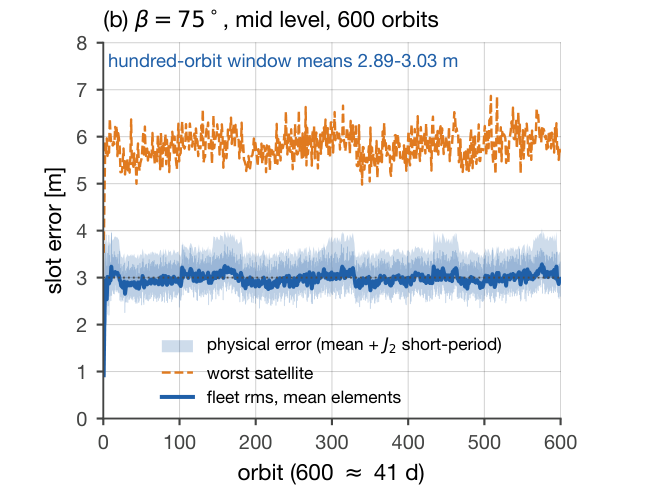
The controller combines environmental-force control in the orbital plane with a scheduled inclination-control channel. The displayed case includes navigation and pointing errors, at a Sun angle of 75° and a mid-level solar environment. RMS tracking error describes formation-keeping; it is not a minimum-separation guarantee.
The paper separately studies passive separation after failures and trades among formation geometry, annual inclination-control cost, and survival of keep-out constraints.
My mission-autonomy work evaluates compact vision-language models for spacecraft tasking. I measure whether they improve mission outcomes, how they fail, and when established planning and control methods can turn a proposed activity into an executable plan.
I also organized the MIT–FOI/FMV collaboration on formation flight and contribute to space-robotics simulation through mjorbit.
03 / Current postdoctoral research
Precise pointing is a system problem. Sensors, flexible structures, disturbances, and actuators all contribute to the motion of an instrument’s line of sight.
At MIT’s Robotic Exploration Lab, I work with Zac Manchester on high-precision spacecraft pointing with uncertain, flexible dynamics. I also lead development of the WiggleSat mission concept, which explores telescope pointing without reaction wheels, building on Zac’s prior research.
I am interested in how calibrated sensors, a good dynamics model, and alternative actuation can work together. The goal is to identify which errors can be estimated and compensated for, and which should set the hardware requirements.
Spacecraft projects
Led ADCS development, wrote flight code, and advised student teams through launch and ISS deployment in 2022.
Mission paper →Designed the three-magnetorquer, one-reaction-wheel architecture and developed the control methods underlying the mission’s control stack. Launch planned for spring 2027.
Lead development of a reaction-wheel-free CubeSat telescope-pointing concept and coordinate research collaborations.
Evaluated optics and ADCS for a MIT–WHOI–University of Arizona ocean-color mission concept, comparing 6U and 12U designs against a 15 m ground-sampling requirement.
My earlier research with Leia Stirling used computational models to connect spacesuit hip-bearing geometry to joint dynamics and range of motion.
Full research archive →